Geoffrey Hinton tells us why he’s now scared “I have suddenly switched my views on whether these things are going to be more intelligent than us".
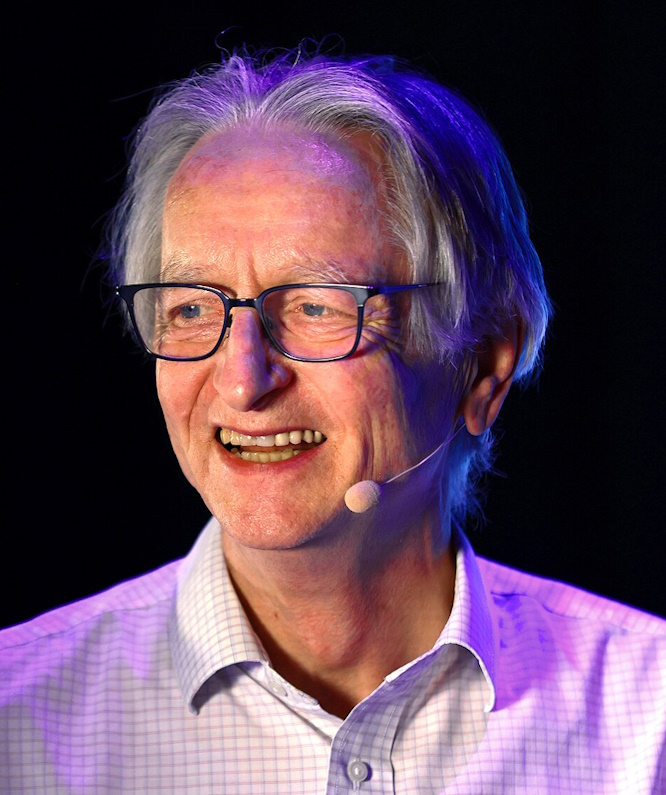
- Technologyreview: Geoffrey Hinton tells us why he’s now scared of the tech he helped build
“I have suddenly switched my views on whether these things are going to be more intelligent than us“.
I met Geoffrey Hinton at his house on a pretty street in north London just four days before the bombshell announcement that he is quitting Google. Hinton is a pioneer of deep learning who helped develop some of the most important techniques at the heart of modern artificial intelligence, but after a decade at Google, he is stepping down to focus on new concerns he now has about AI.
Stunned by the capabilities of new large language models like GPT-4, Hinton wants to raise public awareness of the serious risks that he now believes may accompany the technology he ushered in.
At the start of our conversation, I took a seat at the kitchen table, and Hinton started pacing. Plagued for years by chronic back pain, Hinton almost never sits down. For the next hour I watched him walk from one end of the room to the other, my head swiveling as he spoke. And he had plenty to say.
The 75-year-old computer scientist, who was a joint recipient with Yann LeCun and Yoshua Bengio of the 2018 Turing Award for his work on deep learning, says he is ready to shift gears.
I’m getting too old to do technical work that requires remembering lots of details,”
he told me.
“I’m still okay, but I’m not nearly as good as I was, and that’s annoying.”
Leaving Google will let him speak his mind, without the self-censorship a Google executive must engage in.
“I want to talk about AI safety issues without having to worry about how it interacts with Google’s business,”
he says.
“As long as I’m paid by Google, I can’t do that.”
That doesn’t mean Hinton is unhappy with Google by any means. “It may surprise you,” he says. “There’s a lot of good things about Google that I want to say, and they’re much more credible if I’m not at Google anymore.”
Hinton says that the new generation of large language models—especially GPT-4, which OpenAI released in March—has made him realize that machines are on track to be a lot smarter than he thought they’d be. And he’s scared about how that might play out.
“These things are totally different from us,”
he says.
“Sometimes I think it’s as if aliens had landed and people haven’t realized because they speak very good English.”
Foundations
Hinton is best known for his work on a technique called backpropagation, which he proposed (with a pair of colleagues) in the 1980s. In a nutshell, this is the algorithm that allows machines to learn. It underpins almost all neural networks today, from computer vision systems to large language models.
It took until the 2010s for the power of neural networks trained via backpropagation to truly make an impact. Working with a couple of graduate students, Hinton showed that his technique was better than any others at getting a computer to identify objects in images. They also trained a neural network to predict the next letters in a sentence, a precursor to today’s large language models.
One of these graduate students was Ilya Sutskever, who went on to cofound OpenAI and lead the development of ChatGPT.
“We got the first inklings that this stuff could be amazing,”
says Hinton.
“But it’s taken a long time to sink in that it needs to be done at a huge scale to be good.”
Back in the 1980s, neural networks were a joke. The dominant idea at the time, known as symbolic AI, was that intelligence involved processing symbols, such as words or numbers.
But Hinton wasn’t convinced. He worked on neural networks, software abstractions of brains in which neurons and the connections between them are represented by code. By changing how those neurons are connected—changing the numbers used to represent them—the neural network can be rewired on the fly. In other words, it can be made to learn.
“My father was a biologist, so I was thinking in biological terms,” says Hinton. “ And symbolic reasoning is clearly not at the core of biological intelligence.“
“Crows can solve puzzles, and they don’t have language. They’re not doing it by storing strings of symbols and manipulating them. They’re doing it by changing the strengths of connections between neurons in their brain. And so it has to be possible to learn complicated things by changing the strengths of connections in an artificial neural network.”
A new intelligence
For 40 years, Hinton has seen artificial neural networks as a poor attempt to mimic biological ones. Now he thinks that’s changed: in trying to mimic what biological brains do, he thinks, we’ve come up with something better.
“It’s scary when you see that,”
he says.
“It’s a sudden flip.”
Hinton’s fears will strike many as the stuff of science fiction. But here’s his case.
As their name suggests, large language models are made from massive neural networks with vast numbers of connections. But they are tiny compared with the brain.
“Our brains have 100 trillion connections,”
says Hinton.
“Large language models have up to half a trillion, a trillion at most. Yet GPT-4 knows hundreds of times more than any one person does. So maybe it’s actually got a much better learning algorithm than us.”
Compared with brains, neural networks are widely believed to be bad at learning: it takes vast amounts of data and energy to train them. Brains, on the other hand, pick up new ideas and skills quickly, using a fraction as much energy as neural networks do.
“People seemed to have some kind of magic,”
says Hinton.
“Well, the bottom falls out of that argument as soon as you take one of these large language models and train it to do something new. It can learn new tasks extremely quickly.”
Hinton is talking about “few-shot learning,” in which pretrained neural networks, such as large language models, can be trained to do something new given just a few examples. For example, he notes that some of these language models can string a series of logical statements together into an argument even though they were never trained to do so directly.
Compare a pretrained large language model with a human in the speed of learning a task like that and the human’s edge vanishes, he says.
What about the fact that large language models make so much stuff up? Known as “hallucinations” by AI researchers (though Hinton prefers the term “confabulations,” because it’s the correct term in psychology), these errors are often seen as a fatal flaw in the technology. The tendency to generate them makes chatbots untrustworthy and, many argue, shows that these models have no true understanding of what they say.
Hinton has an answer for that too: bullshitting is a feature, not a bug.
“People always confabulate,”
he says. Half-truths and misremembered details are hallmarks of human conversation:
„Confabulation is a signature of human memory. These models are doing something just like people.”
The difference is that humans usually confabulate more or less correctly, says Hinton. To Hinton, making stuff up isn’t the problem. Computers just need a bit more practice at it.
We also expect computers to be either right or wrong—not something in between.
“We don’t expect them to blather the way people do,”
says Hinton. “When a computer does that, we think it made a mistake. But when a person does that, that’s just the way people work. The problem is most people have a hopelessly wrong view of how people work.”
Of course, brains still do many things better than computers: drive a car, learn to walk, imagine the future. And brains do it on a cup of coffee and a slice of toast.
“When biological intelligence was evolving, it didn’t have access to a nuclear power station,”
he says.
Hinton’s point is that if we are willing to pay the higher costs of computing, there are crucial ways in which neural networks might beat biology at learning. (But it’s worth pausing to consider what those high costs entail.)
Learning is just the first string of Hinton’s argument. The second is communicating.
“If you or I learn something and want to transfer that knowledge to someone else, we can’t just send them a copy,”
he says.
“But I can have 10,000 neural networks, each having their own experiences, and any of them can share what they learn instantly. That’s a huge difference. It’s as if there were 10,000 of us, and as soon as one person learns something, all of us know it.”
What does all this add up to? Hinton now thinks there are two types of intelligence in the world: animal brains and neural networks.
“It’s a completely different form of intelligence,”
he says.
“A new and better form of intelligence.”
That’s a huge claim. But AI is a polarized field: it would be easy to find people who would laugh in his face—and others who would nod in agreement.
People are also divided on whether the consequences of this new form of intelligence, if it exists, would be beneficial or apocalyptic.
“Whether you think superintelligence is going to be good or bad depends very much on whether you’re an optimist or a pessimist,”
he says.
“If you ask people to estimate the risks of bad things happening, like what’s the chance of someone in your family getting really sick or being hit by a car, an optimist might say 5% and a pessimist might say it’s guaranteed to happen. But the mildly depressed person will say the odds are maybe around 40%, and they’re usually right.”
Which is Hinton? “I’m mildly depressed,” he says. “Which is why I’m scared.”
How it could all go wrong
Hinton fears that these tools are capable of figuring out ways to manipulate or kill humans who aren’t prepared for the new technology.
Impressum